

Tokenizing Market Auction Mechanics
Can We Teach An Indicator to Speak the Market
Important: ATS strategies, alerts, strategy licenses, research posts, backtests, forward tests, and downloadable materials are provided for educational, research, and simulated-trading purposes only. Nothing published by ATS is financial advice, investment advice, personalized trading advice, or a recommendation to buy or sell any futures contract live. Any ATS strategy license grants access to strategy research and educational materials for personal study, backtesting, and simulated trading. It does not authorize, instruct, or recommend live futures trading. Backtests are based on historical data and are hypothetical. Forward tests may use live market data, but they are run in simulated accounts unless explicitly stated otherwise. Simulated results do not involve real capital, real execution risk, real slippage, real commissions, emotional pressure, or the possibility of account liquidation. There is no guarantee that any ATS strategy will perform the same way in the future. Futures trading is extremely risky and can result in substantial losses. Anyone who chooses to trade futures live does so independently and should use only risk capital they can afford to lose.If you have any question, comments or concerns, please contact me here: AutomatedTradingStrategies@protonmail.com
“There is nothing new in Wall Street.”
Jesse Livermore, Reminiscences of a Stock Operator, 1923
A market is an argument. Every second, buyers and sellers haggle over the right price, and the number you see on the screen is just the last thing that was agreed on. You have options when entering the argument. You can grab whatever's offered right now, or you can sit back, rest your orders, and let the market come to you.
Modern data lets you watch that whole fight in detail: who pushed, at what price, how hard, and whether the price actually moved when they did. Traders call this record the order flow. Think of it as the transcript of the argument.
There’s a catch, however. That transcript is exhaustive. Thousands of numbers an hour, far more than any human can read while a market is moving.
Enter AI.
Language models, the ChatGPT/Claude kind, work by chopping writing into small pieces called tokens, then learning which runs of pieces carry meaning. That’s the core trick. A few months ago I pointed the same trick at the order flow. I taught a chart tool to squeeze that fire hose of numbers down to a small set of plain word labels, one for each move the argument tends to make. What came back wasn’t really an indicator. It was a loop.

If you’ve never thought in loops, here’s the whole idea, and you already run one every day. Driving, you drift toward the shoulder, you feel it, you nudge the wheel, you check again.
Do a thing. Measure what actually happened. Adjust. Go again.
Norbert Wiener worked out the math of this in the 1940s and named the field after the Greek word for a ship’s steersman. He made the following observations:
Feedback that only shoves you back on course is control.
Feedback that changes how you steer in the first place is, in his words, “a process which may well be called learning.”
So a thermostat controls; a driver who notices she keeps drifting and changes how she holds the wheel is learning. I wanted the second kind on a price chart.
Loop Development
The ordinary way to get an AI to do something is to prompt it. You type an instruction, it answers, and you cross your fingers. That’s fine for a birthday poem. It’s a poor way to build anything that has to survive the real world, because a prompt is a single guess with no way of ever finding out if it was wrong. A loop is that same guess with a grade and a data request stapled to it.
A prompt is a request; a loop is a goal.
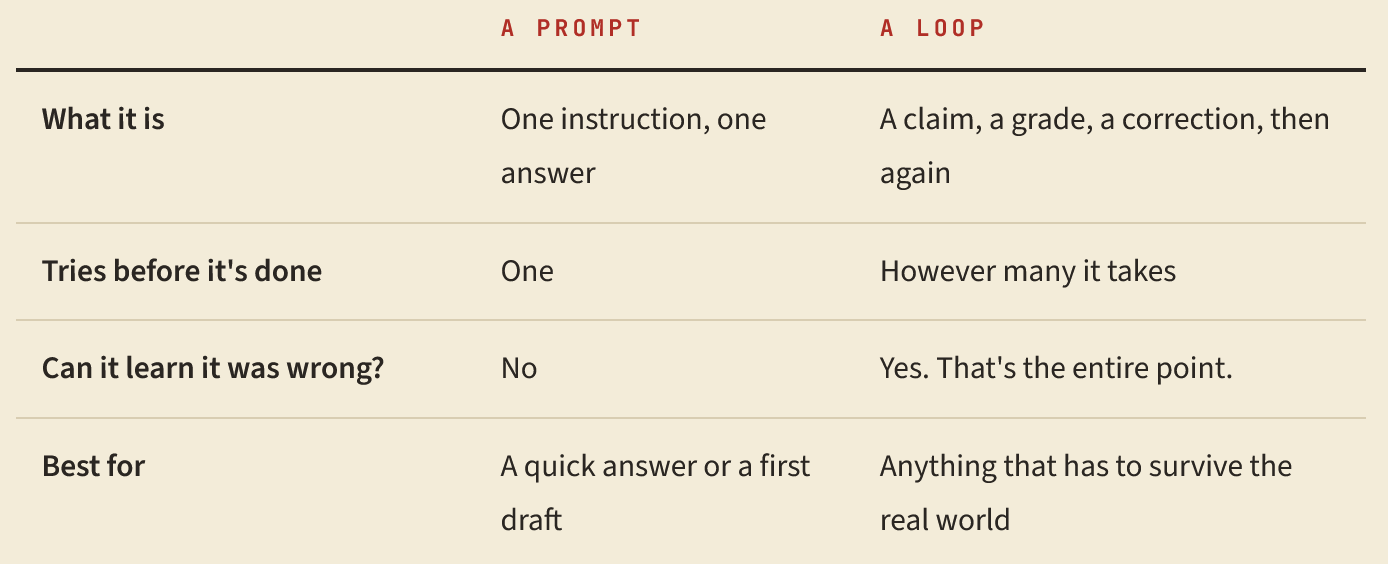
Remember Wiener’s line. One instruction is control. A result that changes what you do next is learning. I never prompted this tool into being. I built the loop and let it grind until a single label could prove it had earned its keep. What you’re seeing below is the loop’s output run for a 5 hr block on 100x market speed:
The tool watches the transcript and makes an observation about what just happened. It writes that observation down with the exact price and time. A few minutes later it looks at what price actually did and hands its own observation a grade. It is holding itself accountable. Observations that score well earn a louder voice and vice versa. Then it goes around again.
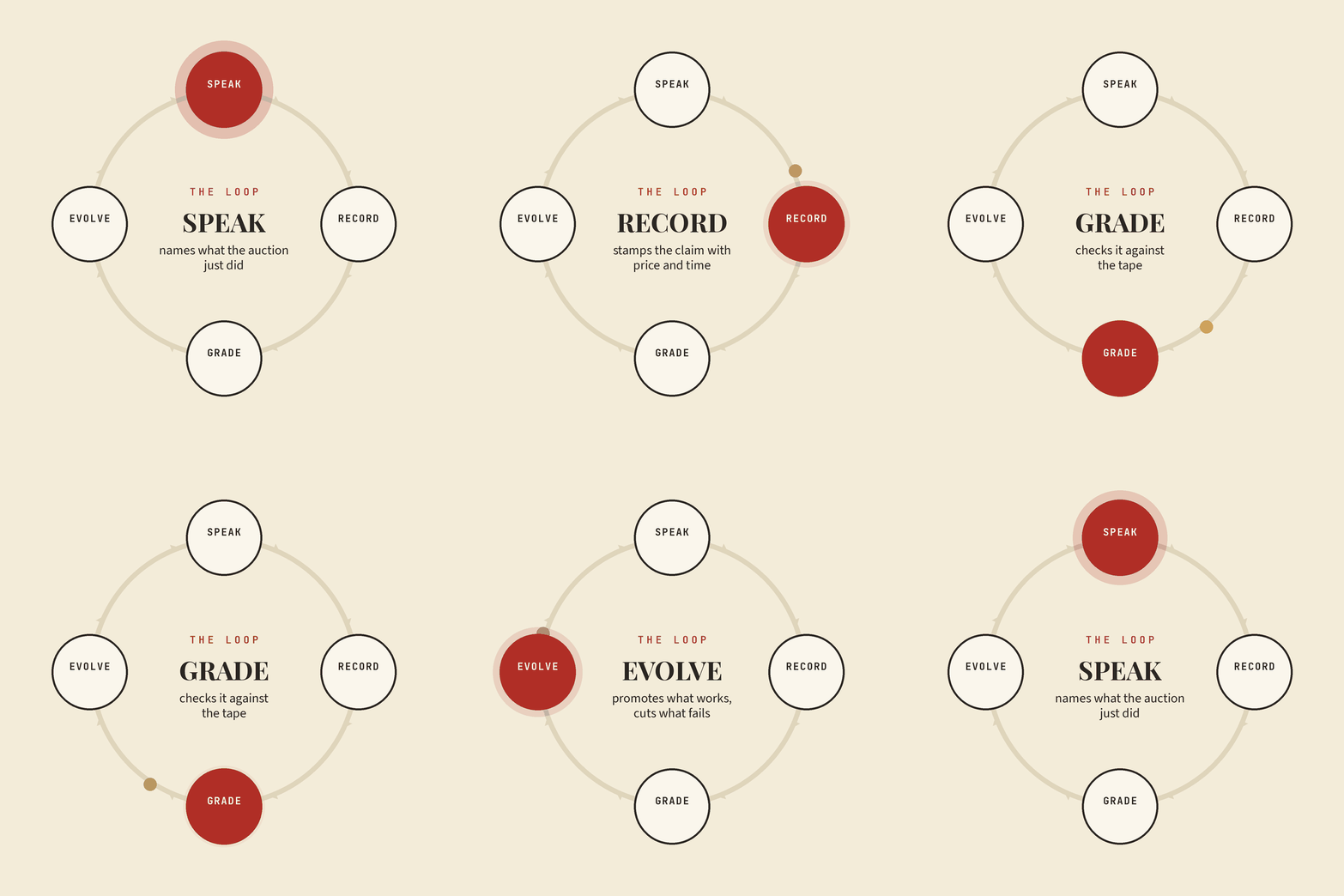
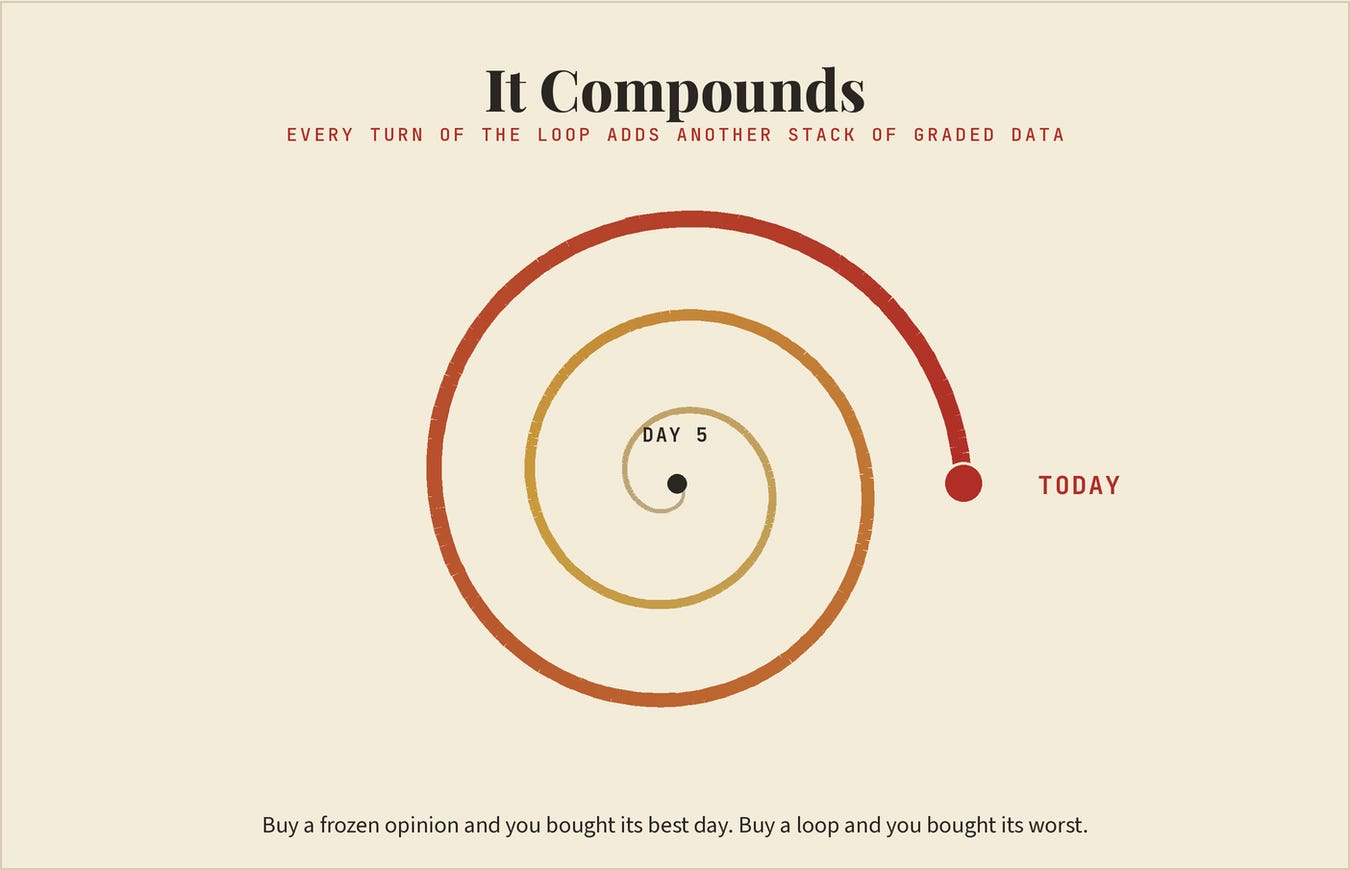
Every day the loop runs, it banks another stack of graded calls, and every graded call is a vote on which words have earned their voice and which are bluffing.
The Auction Translator you’re getting today is not the same version that ran on day five (original post). Back then it spoke up at nearly everything, trusted labels that have since been benched. By the one measure I actually trust, how often it’s right when it decides to speak, it is many times sharper now than it was that first week. The only thing that changed it was time on the tape.
That’s the quiet promise of a loop, and it runs opposite to how market indicators and strategies tend to age: a frozen opinion peaks the day it’s made and fades from there. A loop starts at its worst and climbs, like AI.
The market has a language, and that language continues to grow. My goal is to teach a machine to speak it fluently.
The Auction Translator: 2.0
This is the second iteration of the Auction Translator. The first was based on 1 week of data, now we have 7 weeks of looped data. 7 weeks of learning.